
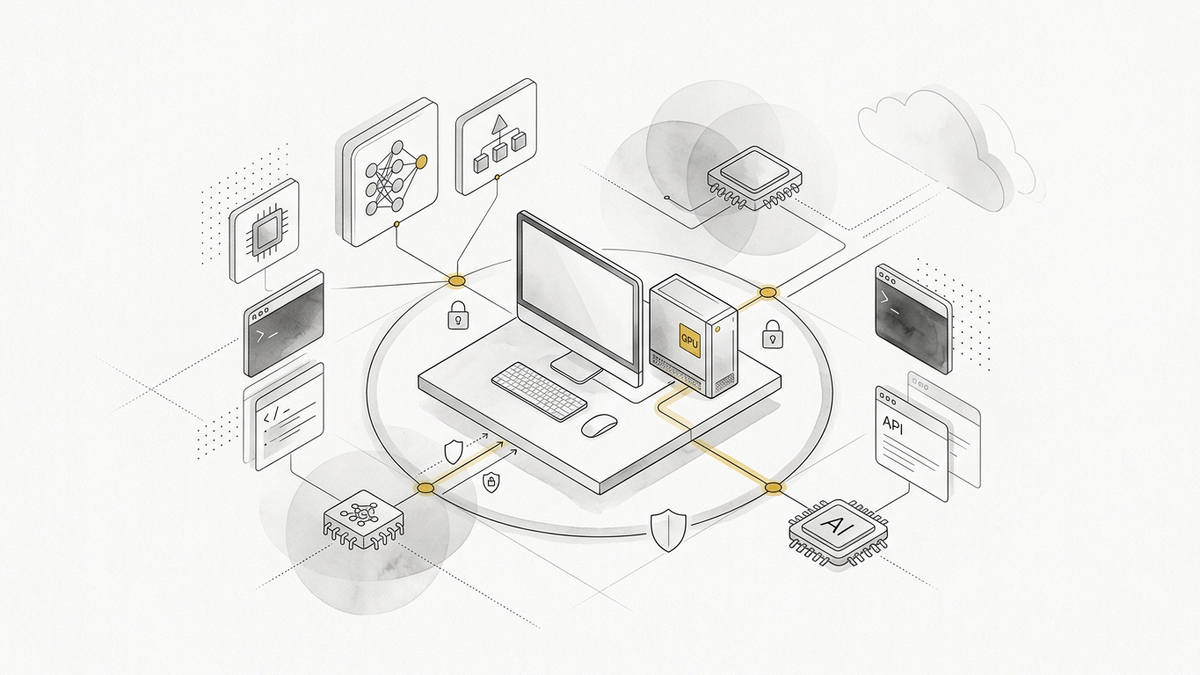
Why More Businesses Are Running AI Locally

Cloud AI made artificial intelligence accessible. It also made every query, every document, and every piece of internal data someone else's problem to process. For most consumer applications, that trade-off is acceptable. For businesses in regulated industries, or any company with genuinely sensitive data, it is not.
Local LLMs are changing that calculation. Running an AI model entirely on your own hardware, with no data leaving your network, used to be a research project. In 2025, it is an engineering discipline with mature tooling, clear cost models, and production-grade performance [1].
What Changes When the Model Lives on Your Hardware
The difference between a cloud-based LLM and a local one is simple to state and significant in practice.
A cloud model processes your data on external servers. Your query leaves your network, travels to a third-party data centre, gets processed, and returns as a response. The provider's infrastructure handles it. The provider's policies govern what happens to it. For general tasks, most companies accept this without concern.
For a law firm reviewing privileged communications, a hospital processing patient records, or a financial institution analysing proprietary transaction data, the equation is different. A Deloitte survey found that 55% of enterprises avoid at least some AI use cases due to data security concerns, while an IBM industry survey found that 57% cite data privacy as the biggest inhibitor to AI adoption [8].
Local LLMs remove that barrier entirely. Self-hosted LLMs process all data on your hardware with zero data leaving your network, meeting GDPR, HIPAA, and SOC 2 compliance requirements by design [1]. No third-party server ever touches the input. No query appears in an external provider's logs. The audit trail stays entirely within your own infrastructure.
Security researchers have found databases containing almost 12,000 active API keys and passwords exposed through cloud integrations. In a separate incident, a customer service chatbot was tricked through prompt injection into disclosing other customers' account and order information [5]. Both failures had one thing in common: the data was being processed externally.
The Open-Source Models Making This Possible
Three years ago, running a capable LLM locally required hardware and expertise that placed it out of reach for most businesses. That has shifted.
The capability gap between open-source and closed models has largely been bridged. Models like DeepSeek R1, Qwen 3, and Llama 4 now reach GPT-4-level performance on many benchmarks [5]. Meta's LLaMA family remains one of the most widely deployed starting points for local deployment, offering models across a range of sizes that run on hardware from a single workstation GPU up to multi-GPU server clusters.
Hardware has also improved dramatically. The RTX 5090, released in 2025, delivers 1.79TB/s memory bandwidth versus 1.01TB/s from the previous RTX 4090 [5]. That jump in raw throughput directly translates to faster local inference. Models that previously required expensive data centre hardware now run adequately on high-end consumer GPUs.
Quantization has made the memory requirements far more manageable. INT4 quantization transforms a 140GB FP16 70B-parameter model down to 35GB, enabling private AI deployment on consumer-grade hardware without significant quality loss [1]. A model that once required four high-end GPUs can now run on one, or even on a well-specced workstation.
The tooling layer has matured to match. Tools like Ollama, LM Studio, and llama.cpp handle model loading, quantization, and inference with minimal configuration, while vLLM and LocalAI provide OpenAI-compatible API endpoints that allow existing applications to migrate to local deployment with minimal code changes [7].
The Cost Argument: When Local Beats Cloud
The financial case for local deployment depends on usage volume. At low volumes, cloud APIs are cheaper. The upfront cost of hardware is zero, billing is pay-per-use, and no one needs to maintain the infrastructure. At high volumes, that model inverts.
A typical cloud API charges around $0.002 per 1,000 tokens. For high-volume applications, that accumulates to thousands of dollars monthly. Local LLMs require only the initial hardware investment and ongoing electricity costs, with unlimited usage once deployed [3]. Research across 54 deployment scenarios gives a clearer picture of where the break-even sits. At moderate usage volumes, mid-size open-source models become economically attractive with break-even horizons of 3.5 to 69.3 months depending on the specific model and cloud provider being replaced [4].
For organisations already running GPU infrastructure for other workloads, the incremental cost of adding a local LLM is lower still, since the hardware investment is partially shared.
A hybrid approach offers a middle path. Research published in September 2025 found that a hybrid strategy, routing most queries to a local model and escalating to a cloud model only when confidence is low, reduces costs by approximately 61% compared to a cloud-only approach while reducing median response latency by 40% [6]. Sensitive queries stay local. Complex queries that benefit from a larger model go to the cloud. Each query is routed based on its requirements rather than a one-size-fits-all policy.
The Control Argument: What You Own That Cloud Cannot Give You
Beyond privacy and cost, local deployment gives a business a type of control that no cloud subscription can match.
With a cloud model, the provider decides when the model updates. A change in model behaviour, a new version, a shift in what the model refuses to do, all happen on the provider's timeline. Businesses that built workflows around specific model behaviour have discovered this when an update changes outputs in ways they did not anticipate and cannot reverse.
On-premise environments give teams full access to model weights and architecture. Teams can fine-tune models on proprietary datasets, modify tokenisation logic, and build highly tailored AI experiences that no cloud service can replicate [10]. A legal firm can fine-tune on its own case library. A financial institution can train on its own policy documents. The model becomes specific to the organisation, not generic across all customers.
Cloud AI platforms often bundle inference APIs, storage, and fine-tuning into proprietary ecosystems. Once a workflow is built around a specific provider, migrating becomes time-consuming and costly [10]. Local deployment removes that dependency. The model is yours. The weights sit on your servers. If a provider raises prices, changes terms, or shuts down a service, your operation continues without interruption.
What the Setup Actually Requires
Local LLM deployment is not plug-and-play at production scale. Being clear about the requirements upfront prevents expensive surprises.
The compute requirement is the most significant. Production deployments need GPUs with sufficient VRAM to hold the model weights and handle concurrent requests. A 7 billion parameter model runs on a single RTX 4090 with 24GB VRAM. A 70 billion parameter model needs multiple GPUs or a server-grade card. The right choice depends on the model size required, the number of concurrent users, and the acceptable response latency [1].
Beyond hardware, the team needs someone who can configure and maintain the inference stack. The full production architecture spans hardware selection, operating system tuning, containerised inference engines, and observability pipelines with metrics tracking time to first token, tokens per second, and queue depth [9]. That is standard infrastructure engineering, but it is infrastructure engineering that someone on the team needs to own.
The good news is that the tooling has matured to the point where most of this complexity is manageable without specialised AI expertise. Tools like Ollama and LM Studio make local deployment accessible to developers without deep ML backgrounds, while vLLM handles production multi-user serving with high-throughput concurrent request handling [7].
Who Should Be Looking at This Now
Local LLMs are not the right choice for every business or every use case. The decision comes down to three variables: data sensitivity, usage volume, and technical capacity.
Local deployment makes strong sense when data privacy and regulatory compliance are non-negotiable, when you process more than two million tokens daily with consistent usage patterns, when latency requirements demand sub-second response times, or when you need deep customisation through fine-tuning on proprietary data [5].
Healthcare providers use offline LLMs to analyse patient interactions while adhering to HIPAA requirements. Financial institutions rely on local models to safeguard transaction data and comply with confidentiality standards. The US Department of Defense has explored offline LLMs for analysing classified data without exposing information to external networks [2].
For businesses that do not yet process high volumes, cloud APIs remain the faster and cheaper starting point. The realistic path for most companies is cloud-first experimentation followed by selective migration of high-volume or sensitive workloads to local infrastructure once the use cases are proven.
The open-source models are strong enough now. The hardware is accessible enough now. The tooling is mature enough now. For businesses that handle data they cannot afford to share, the case for running AI on their own terms has never been more practical.
References
- Digital Applied — Local LLM Deployment: Privacy-First AI Complete Guide: https://www.digitalapplied.com/blog/local-llm-deployment-privacy-guide-2025
- God of Prompt — Local LLM Setup for Privacy-Conscious Businesses: https://godofprompt.ai/blog/local-llm-setup-for-privacy-conscious-businesses/
- Binadox — Best Local LLMs for Cost-Effective AI Development in 2025: https://www.binadox.com/blog/best-local-llms-for-cost-effective-ai-development-in-2025/
- arXiv — A Cost-Benefit Analysis of On-Premise Large Language Model Deployment: https://arxiv.org/html/2509.18101v3
- Unified AI Hub — On-Prem LLMs vs Cloud APIs: When to Run Models Locally: https://www.unifiedaihub.com/blog/on-premise-llms-vs-cloud-apis-when-to-run-your-ai-models-on-premise
- Journal of ISI — Hybrid Cloud Architecture for Efficient and Cost-Effective LLM Deployment: https://journal-isi.org/index.php/isi/article/download/1170/595
- LocalLLM.in — How to Run a Local LLM: A Comprehensive Guide for 2025: https://localllm.in/blog/how-to-run-local-llm-guide-2025
- Allganize — Cloud vs On-Prem LLM: 3 Factors That Decide the Right Deployment: https://www.allganize.ai/en/blog/enterprise-guide-choosing-between-on-premise-and-cloud-llm-and-agentic-ai-deployment-models
- SitePoint — Enterprise Local LLM Deployment: vLLM, GPUs and the Full Stack: https://www.sitepoint.com/the-2026-definitive-guide-to-running-local-llms-in-production/
- TrueFoundry — On-Premise LLM Deployment: Secure and Scalable AI Solutions: https://www.truefoundry.com/blog/on-prem-llms