
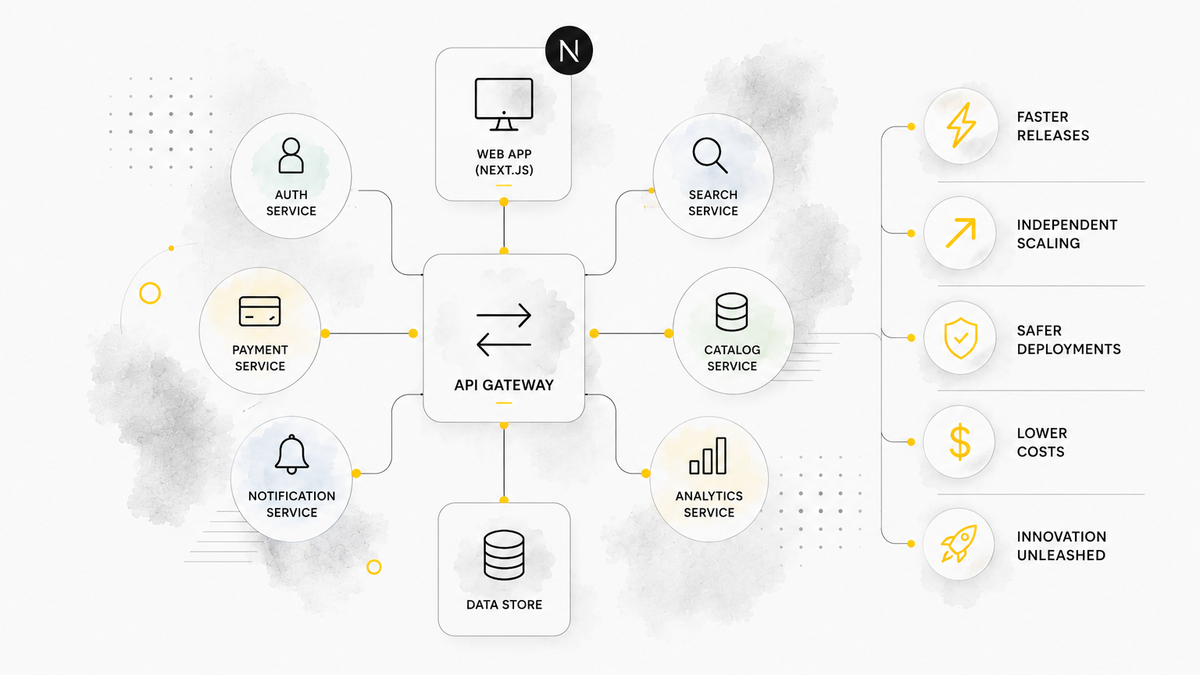
The $200M evolution: why corporations are abandoning bloated architectures for agile Next.js microservices.

Large companies have long measured technical debt in abstract terms: slower releases, harder hiring, rising maintenance costs. In 2025, that debt has a sharper number attached to it. Maintaining legacy systems can consume up to 80% of IT budgets, leaving only a fraction available for anything that actually moves the business forward [1]. For many enterprises, that ratio has become impossible to defend.
The response is a structural shift. Companies are breaking apart their monolithic architectures and replacing them with smaller, independently deployable services. Next.js has become a central piece of that new stack for teams building web-facing products. The combination of modular architecture and a framework built for performance and developer speed is reshaping how large organizations think about their frontend infrastructure.
What a Monolith Actually Costs
A monolithic application is a single codebase where every component, business logic, data access, and user interface sits together. It ships as one unit. It scales as one unit. When one part breaks, the whole system is at risk.
That design made sense when teams were small and products were simple. It stops making sense at scale. When a minor change in one module can delay an entire release, development slows down across every team touching that codebase [2]. Engineers spend more time coordinating than building. A bug in one area can affect the entire system, not just the component where it originated.
The numbers from enterprises that have gone through this pain are consistent. 74% of enterprises now report plans to move away from monoliths by 2026 [3]. 67% of CIOs list microservices adoption among their top three modernization priorities [3]. These are not speculative plans driven by industry trends. They are responses to concrete operational problems that have become expensive enough to force action.
The Microservices Shift: What It Actually Means
Microservices architecture breaks an application into small, independent services, each responsible for a specific function. Each service runs separately, scales separately, and can be updated without touching anything else in the system [4].
The business impact is measurable. Teams working on one service do not need to wait for teams working on another. A payment service can be updated without touching the notification service. A search feature can scale during peak traffic without provisioning resources for the entire application. The cloud microservices market reflects this momentum: it is projected to grow from $2 billion in 2025 to $5.61 billion by 2030 [4].
The security case is equally clear. A vulnerability in one service does not automatically expose every other service. Breaches can be isolated, identified faster, and contained before spreading across the system. That isolation is significantly harder to achieve when everything shares the same deployment.
The approach is not without trade-offs. Microservices have higher initial infrastructure costs than monoliths [5]. Teams below ten developers often find that monoliths perform better and require less operational overhead [5]. The architecture benefits appear when teams are large enough, and the product complex enough, to actually need independent scaling and deployment. Amazon, known for years as a microservices pioneer, is now grouping services into well-bounded contexts rather than treating every function as a separate service, a signal that the industry is maturing toward balance over ideology [6].
Where Next.js Fits Into This Picture
Next.js has become the frontend layer of choice for enterprises rebuilding their web presence on top of distributed backends. The framework runs on over 201,000 active domains as of mid-2025, with 9.5% of users being companies with more than 10,000 employees, including Amazon, IBM, Siemens, Accenture, and Oracle [7].
The adoption is not driven by trend-following. It is driven by concrete technical advantages that matter at enterprise scale.
Server-side rendering means the server builds a fully rendered HTML page before sending it to the browser. The user sees content faster. Search engines can index it without waiting for JavaScript to execute. For large content-heavy sites or e-commerce platforms, those two properties translate directly into better performance metrics and better search rankings [8].
Static site generation pre-builds pages at compile time and serves them from a content delivery network. Pages load with near-zero latency. Infrastructure costs drop because fewer server resources are needed per request. For pages that do not need real-time data, this is the fastest possible delivery method [8].
Incremental static regeneration sits between the two. It lets specific pages rebuild in the background as content updates, without triggering a full rebuild of the entire site. An enterprise with thousands of product pages or location pages can update individual pages on demand while the rest of the site continues serving cached content [9].
Together, these three rendering modes let teams choose the right approach for each type of content rather than applying one method across everything. That flexibility is difficult to achieve in a traditional monolithic frontend.
The Developer Experience Argument
Architecture decisions at enterprises are rarely made on technical merit alone. They are also made on the basis of how fast teams can build, how easily new engineers can onboard, and how much time gets spent on maintenance versus new features.
Next.js scores well on all three. It handles routing, code splitting, image optimization, and API routes within the same framework. A team does not need separate tools stitched together to cover those functions [9]. Features like hot reload and minimal configuration mean less friction in day-to-day development [10].
Companies like Nike, Spotify, Netflix, TikTok, Notion, and Stripe have all moved production workloads onto Next.js [11]. These are organizations with large engineering teams, complex requirements, and high traffic. Their adoption is a signal that the framework holds up under conditions that would expose the weaknesses of a less mature tool.
The Migration Path: Incremental Over Everything
One common mistake in architectural modernization is attempting too much at once. A full rewrite of a large system introduces enormous risk: months of work with no user-facing value delivered, and a high chance of introducing new problems while solving old ones.
The approach that works is incremental. The strangler fig pattern is the most widely adopted method: extract one service, route traffic to it, retire the old module, and repeat [2]. Teams typically start with clearly bounded services, payment gateways, notification systems, authentication, or product catalog, because these have the least internal dependencies and can deliver visible wins early.
In practice, this means a company can keep its existing monolith running while building the new architecture in parallel. Each extracted service reduces the load on the monolith. Over time, the old system shrinks and the new distributed system grows until the migration is complete, without a single day of downtime or a big-bang cutover [4].
What the Numbers Say
The ROI from these migrations is real and measurable. A transportation provider that modernized its architecture with a microservices approach now saves over $5,000 monthly in infrastructure costs [4]. Three out of four enterprises have already undertaken at least limited-scale modernization, with 59% of planned spending now focused on transforming existing legacy systems rather than building new infrastructure [1].
At the framework level, teams using Next.js consistently report improvements across the metrics that matter most to enterprise stakeholders: faster deployment cycles, better Core Web Vitals scores, and reduced time spent on infrastructure maintenance [9].
The shift is not a bet on a technology trend. It is a response to a cost structure that no longer makes sense for how fast products need to move. Breaking apart a bloated architecture is slow, expensive work. Staying inside one is proving to be more expensive over time.
References
- Neontri — Monolith to Microservices Migration: Key to Scalability: https://neontri.com/blog/monolith-microservices-migration/
- KodekX — Monolith to Microservices: 2025 Migration Strategy: https://www.kodekx.com/blog/monolith-to-microservices-migration-2025-strategy
- HakunamatataTech — Monolithic to Microservices Migration Guide 2025: https://www.hakunamatatatech.com/our-resources/blog/microservices
- Acropolium — Migrating from Monolith to Microservices: Strategy & 2025 Guide: https://acropolium.com/blog/migrating-monolith-to-microservices/
- Medium — Monolith vs Microservices 2025: Real Cloud Migration Costs: https://medium.com/@pawel.piwosz/monolith-vs-microservices-2025-real-cloud-migration-costs-and-hidden-challenges-8b453a3c71ec
- Foojay — Monolith vs Microservices in 2025: https://foojay.io/today/monolith-vs-microservices-2025/
- TechnologyChecker — Companies Using Next.js in 2026: https://technologychecker.io/technology/next-js
- Gautam IT Services — Why Use Next.js in 2025: Benefits and Use Cases: https://www.gautamitservices.com/blogs/why-use-nextjs-in-2025-benefits-and-use-cases
- IODigital — Next.js at Enterprise Level: https://techhub.iodigital.com/articles/nextjs-at-enterprise-level
- Pattem Digital — Next.js for Enterprise: Scalability and Performance: https://www.pattemdigital.com/insight/next-js-for-enterprise
- Aalpha — Next.js Pros and Cons and Use Cases 2026: https://www.aalpha.net/articles/nextjs-advantages-and-disadvantages/