
Cybersecurity in the Age of AI Agents: The New Vulnerabilities Developers Are Fixing in APIs and Webhooks

Businesses are deploying AI agents faster than security teams can study them. These systems no longer just answer questions. They reach into databases, trigger payments, send emails, update records, and talk to third-party platforms without waiting for a human to press a button. That capability is the point. It is also the risk.
Traditional software security was built around a known and mostly predictable execution path. An attacker who found a flaw in the code could exploit it in a specific way. AI agents do not follow static code paths. Their behavior shifts based on prompts, context, and model updates. That makes predicting, monitoring, and containing their actions far harder than it is with conventional applications [1].
How AI Agents Connect to the Outside World
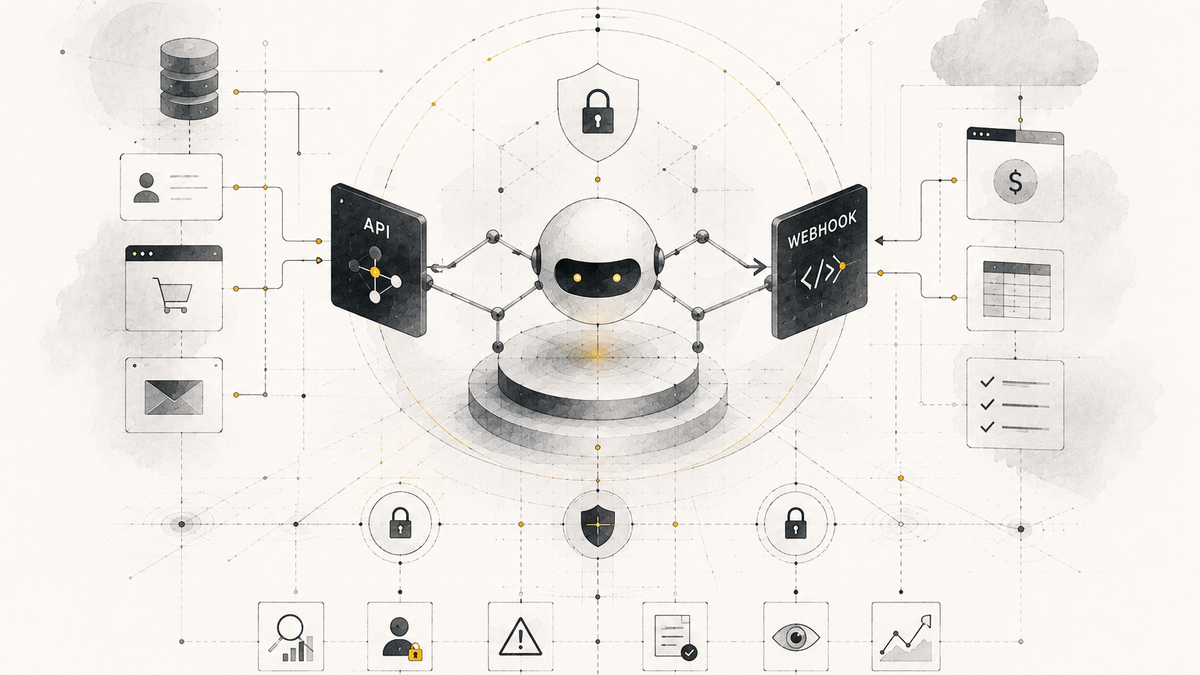
Most AI agents interact with external systems through two mechanisms: APIs and webhooks.
An API lets an agent send a request to another system and receive data or trigger an action. A webhook works in the opposite direction. An external system sends a request to the agent when a specific event occurs, such as a payment completing, a form submitting, or a user signing up.
Together, these two channels give an AI agent enormous reach. A single agent can pull customer records from a CRM, update a project management tool, process a payment, and send a notification, all within a single automated task. Each of those connections is also a door. A compromised API key or an unverified webhook endpoint can hand an attacker access not just to one system but to every system the agent touches [2].
In August 2025, stolen OAuth tokens from an integration breach exposed customer environments across more than 700 organizations [2]. That breach did not require breaking into each system individually. Access to one authentication layer was enough.
The Permission Problem
One of the most direct ways to contain damage from a breach is to keep agent permissions narrow. This is called the principle of least privilege: each agent should access only the data and actions its specific task requires, nothing more.
In practice, this discipline is difficult to maintain. Teams often grant broad access during development to make things work, and those permissions frequently persist into production, increasing security risks [1].
The consequences of over-permissioning are severe. By 2025, 75% of AI security incidents were predicted to result from unauthorized access, and the average cost of a data breach has reached $4.45 million [3]. An agent with access to ten systems when it only needs two doubles the blast radius of any successful attack.
OWASP's AI Agent Security guidelines are direct on this point: give agents unrestricted tool access or wildcard permissions and trust content from external sources without validation and you create conditions for tool abuse, privilege escalation, data exfiltration and goal hijacking [4].
The fix requires treating each AI agent like its own identity. Each agent should act on behalf of users with explicit authorization, with high-privilege actions requiring human approval before execution [5]. Okta's 2025 benchmarks found that using short-lived 300-second access tokens instead of 24-hour sessions reduced credential theft incidents by 92% [3].
Prompt Injection: The Attack That Traditional Security Cannot Stop
Permission controls protect the perimeter. They do not address what happens when an attacker gets inside the agent's reasoning process itself.
Prompt injection is the dominant attack method targeting AI agents today. Unlike traditional software exploits that target code vulnerabilities, prompt injection manipulates the very instructions that guide AI behavior, turning helpful assistants into unwitting participants in data breaches and unauthorized access [6].
The mechanics are straightforward. An attacker hides malicious instructions inside a document, a webpage, an email, or any other content the agent reads. When the agent processes that content, it may interpret the hidden instructions as legitimate commands and act on them.
In 2025, GitHub Copilot suffered from CVE-2025-53773, a vulnerability that allowed remote code execution through prompt injection, potentially compromising the machines of millions of developers [7]. This was not a theoretical proof of concept but a documented breach in a widely used production tool.
Research paints a stark picture of how effective these attacks can be. Just five carefully crafted documents can manipulate AI responses 90% of the time through Retrieval-Augmented Generation poisoning [7]. And OpenAI, even while working to harden its AI browser against attacks, acknowledged that prompt injection is unlikely to ever be fully solved [8].
The risk grows significantly when AI systems are connected to enterprise APIs, cloud systems, databases, support tools, email, and file repositories. In those environments, prompt injection stops being a chatbot problem and becomes an orchestration-layer security issue [9].
Webhook Security: A Frequently Overlooked Gap
Webhooks present a distinct and often underestimated risk. Because they accept incoming requests from external systems, a poorly secured webhook endpoint can receive and act on data from any source, not just trusted ones.
Most development teams implement webhooks without proper security controls, creating attack vectors that bypass traditional API security [10]. The 2023 CircleCI breach occurred when attackers accessed webhook endpoints without proper authentication, compromising thousands of customer secrets [10].
The standard defense is HMAC signature verification. When an external system sends a webhook, it signs the request using a shared secret key. The receiving system recomputes the signature and compares it to what arrived. If they match, the request is genuine. If they do not, the request is rejected. Key defenses for webhook security include HMAC signature verification, strict input validation, rate limiting, and comprehensive logging to detect and reduce threats [11].
Beyond signature checks, research across major platforms shows a consistent failure pattern: inbound requests are accepted without cryptographic signature verification, often via proxy trust exceptions that effectively disable the check in production deployments. Fixing this requires removing those exceptions and applying HMAC validation unconditionally on every incoming request [12].
A Different Kind of Security Challenge
What makes AI agent security genuinely new is not any single attack method. It is the combination of autonomy, reach, and unpredictability.
A traditional application does what it was programmed to do. Its attack surface is fixed and knowable. An AI agent interprets instructions, reads external content, makes decisions, and acts across multiple platforms. Its behavior can shift based on what it reads. AI agent security depends on spotting unusual behavior across sequences of actions, not only single events in isolation [12].
Developers are no longer only protecting users and applications. They are now securing systems that can read, decide, and act on their own. The security controls built for the previous generation of software, static firewalls, role-based access, code-level input validation, address only part of the problem.
The teams getting this right are approaching it differently. They treat every agent as an identity. They scope permissions tightly and review them regularly. They validate every incoming request. They put human approval gates on high-impact actions. And they monitor behavior patterns over time, not just individual log entries.
AI agents will take on more responsibility across business systems. The security layer around them needs to keep up.
References
- WitnessAI — AI Agent Access Control Guide: https://witness.ai/blog/ai-agent-access-control/
- Nango — A Complete Guide to Securing AI Agent API Authentication (2026): https://nango.dev/blog/guide-to-secure-ai-agent-api-authentication/
- Prefactor — 5 Best Practices for AI Agent Access Control: https://prefactor.tech/blog/5-best-practices-for-ai-agent-access-control/
- OWASP — AI Agent Security Cheat Sheet: https://cheatsheetseries.owasp.org/cheatsheets/AI_Agent_Security_Cheat_Sheet.html
- Curity — 8 API Security Best Practices for AI Agents: https://curity.io/resources/learn/api-security-best-practice-for-ai-agents/
- Obsidian Security — Prompt Injection Attacks: The Most Common AI Exploit in 2025: https://www.obsidiansecurity.com/blog/prompt-injection
- MDPI — Prompt Injection Attacks in Large Language Models and AI Agent Systems: https://www.mdpi.com/2078-2489/17/1/54
- TechCrunch — OpenAI Says AI Browsers May Always Be Vulnerable to Prompt Injection Attacks: https://techcrunch.com/2025/12/22/openai-says-ai-browsers-may-always-be-vulnerable-to-prompt-injection-attacks/
- RedBot Security — Prompt Injection Attacks in 2025: https://redbotsecurity.com/prompt-injection-attacks-ai-security-2025/
- APIsec — Securing Webhook Endpoints: Authentication and Validation Best Practices: https://www.apisec.ai/blog/securing-webhook-endpoints-best-practices
- Didit — Securing Webhooks for AI Agents: A Comprehensive Guide: https://didit.me/blog/webhook-security-for-ai-agents-hi/
- Monday.com — AI Agent Security: How to Protect Autonomous Systems: https://monday.com/blog/ai-agents/ai-agent-security-protection/